
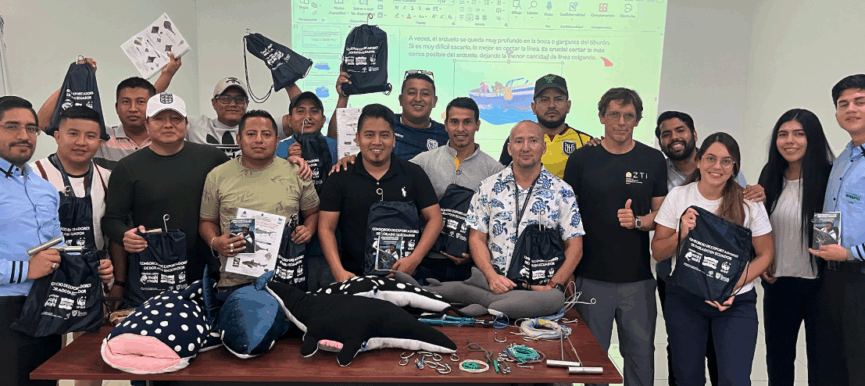
Manta, Ecuador. As part of efforts to strengthen best practices in Ecuador’s longline fisheries and actively contribute to the conservation of vulnerable marine species, the Guide to Best Practices for Handling and Releasing Protected Sharks and Rays has been officially launched. This new educational and technical resource is aimed at captains, crew members, and other key actors within the artisanal and industrial longline fleet.
The guide was developed with support from the Fishery Improvement Projects (FIPs) Conservation Mahi Mahi and Swordfish EC, in collaboration with the Eastern Pacific Fishing School Foundation (EPESPO) and WWF Ecuador. It represents a significant step toward aligning Ecuador’s fisheries with international sustainability standards, including those set by the Marine Stewardship Council (MSC).
“Responsible fishing is not only a commitment to marine biodiversity but also to the future of our sector and our society. With this guide, we want fishers to become active stewards of our oceans,” said Guillermo Morán Velásquez, coordinator of both FIPs.
This user-friendly, visual guide highlights the shark and ray species protected under Ecuadorian regulations—such as hammerhead sharks, whale sharks, sawfish, silky sharks, and various manta rays—all of which must be immediately released when caught. It also offers practical and safe recommendations for handling incidental catch in ways that minimize harm and maximize survival rates of these endangered species. Key tools like de-hookers and stretchers are promoted, along with safe release techniques to protect both the crew and the animal. Incorrect release practices can lead to injuries or fatalities on board, making the adoption of these methods vital for conservation.
The guide is the result of a participatory process involving over 20 artisanal fishing organizations from Manabí and Santa Elena.
“This guide reflects the voices of those who live the ocean every day. Through workshops, we combined international best practices with the valuable knowledge of the fishing sector and transformed it into a practical tool for use at sea,” said Pablo Guerrero, Director of Marine Conservation at WWF Ecuador.
The document also integrates national fishing regulations issued by the competent authority, as well as recommendations from regional bodies such as the Inter-American Tropical Tuna Commission (IATTC). As such, it becomes a key tool for ensuring legal compliance and minimizing the ecological impact of fishing operations.
First round of distribution and training in fishing communities
With the guide now finalized, the first workshop was held on July 11 to begin distributing and socializing its content among artisanal fishers, crew members, and onboard observers in major landing sites across the country—including Manta, Santa Rosa, Anconcito, San Mateo, Puerto López, Santa Marianita, and Jaramijó.
A shared commitment to sustainability
The launch of this guide reinforces the shared commitment between the fishing sector, government authorities, and conservation organizations to protect marine ecosystems.
“This guide is the result of co-creation with fishers who face the challenge of fishing responsibly every day. More than a technical document, it’s a living tool designed to be useful on board, promote best practices, and protect our most vulnerable marine species. Each workshop was a chance to exchange knowledge and strengthen everyone’s commitment to sustainable fishing,” said Valeria Palau, FIP Technician for Conservation Mahi Mahi.
About Conservation Mahi Mahi & Swordfish EC
These Fishery Improvement Projects will continue promoting training in the use of best practices, integrating them as a fundamental part of their pathway toward international standards, including Marine Stewardship Council (MSC) certification.
🌐 www.ConservationMahiMahi.org / www.Swordfish.ec
About WWF Ecuador
WWF is one of the world’s largest conservation organizations, active in over 100 countries and supported by nearly five million people worldwide. Its mission is to build a future in which people live in harmony with nature. WWF has operated in Ecuador for over 20 years, with more than 30 active marine and terrestrial conservation projects.
